


Do you want to find support or learn more about NETs?
Explore helpful resources and connect with the NET community.

Detectnet will expose you to radiation. To help your body get rid of the radiation faster, you should drink plenty of liquids before and after your injection. You should also urinate and wash your hands often after your PET scan. If you are pregnant, there are potential risks of fetal exposure to radiation with Detectnet. If you breastfeed, wait at least 12 hours after you have received Detectnet to breastfeed your infant in order to reduce radiation exposure.
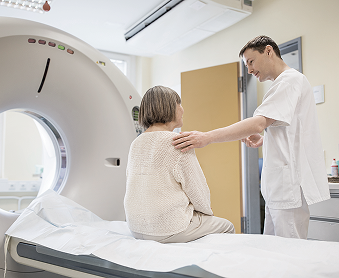
You will be given an injection of Detectnet through an intravenous (IV) line into a vein in your arm or your hand
Your health care team will have you relax while Detectnet spreads throughout your body
After about 45 to 90 minutes, you will be taken to the scan area for your PET scan
The scan usually takes between 20 and 60 minutes
PET scans are not painful, and your health care team will be able to see you and communicate with you
During the scan, special detectors will create a 3-D image of where Detectnet goes in your body
Drink plenty of water prior to receiving Detectnet and urinate as often as possible during the first hours following the injection to help reduce radiation exposure
A nuclear medicine physician or radiologist will review the images and share the results with you and your doctor
Your doctor will use those results to discuss and recommend a treatment plan that’s best for you
Make sure to follow your doctor's instructions on what to do after you receive radiation. Most people are able to return to work, go home, or get on with the rest of their day.
The radiation from a scan has some risk. But the risk from undiagnosed and untreated NETs is greater because they can lead to serious health problems. Be sure to talk to your doctor about the best option for you.

Explore helpful resources and connect with the NET community.

Detectnet™ (copper Cu 64 dotatate injection) is intended for use with a positron emission tomography (PET) scan. It helps to identify certain types of tumors, called neuroendocrine tumors (NETs), in adult patients.
This is not a complete report of risk information for Detectnet. Please speak to your healthcare provider or pharmacist to learn more about Detectnet and see full Prescribing Information (PDF) (opens in a new tab) or visit Detectnet.com.
When radioactive drugs like Detectnet are used to help doctors find disease, they expose patients to radiation. Long-term exposure to radiation is associated with an increased risk of cancer. Your healthcare provider will take safety measures to reduce your exposure to radiation. To help your body get rid of the radiation from Detectnet, you should drink plenty of fluids both before and after receiving it, and urinate often after your scan.
After using Detectnet, some patients reported getting a rash or itchy skin. They usually went away on their own or with normal care. Less commonly, patients had swelling under the skin or another serious, life-threatening, allergic reaction.
Detectnet works by attaching to NETs, which helps the tumors to be seen in your scan. However, there are other types of tumors or normal variations in tissue that Detectnet can also attach to. That means that it’s possible your healthcare provider may see things in your scan that are not necessarily NETs. Also, if you’ve never had a NET before, a negative result—when your healthcare provider sees no NETs—does not guarantee that you do not, or will not, have NETs.
In trials of Detectnet, participants experienced few negative side effects. Adverse reactions occurred at a rate of less than 2% and included nausea, vomiting, and flushing (getting red in the face). In some trials, people felt nauseated right after Detectnet was injected.
Tell your healthcare provider if you are taking any other medications. Somatostatin analogs may affect how Detectnet works. You should stop taking long-acting somatostatin analogs at least 28 days before your Detectnet scan. You should stop taking short-acting somatostatin analogs 2 days before your Detectnet scan.
All radioactive drugs, like Detectnet, can be dangerous to an unborn baby. Be sure to tell your healthcare provider if you are (or could be) pregnant so that you can discuss the risks and benefits of using Detectnet.
If you’re breastfeeding your child, consider pumping and saving breast milk before you have your scan performed. You should not breastfeed for 12 hours after you receive Detectnet. During those 12 hours, bottle-feed using formula or saved breast milk.
It is not known if Detectnet is safe and effective in patients under 18 years of age.
There were not enough trial participants over age 65 to determine if Detectnet works differently in older patients, but other reports have not found differences between the way older and younger patients respond to it. If you are over age 65, your healthcare provider will take your age, overall health, and other medications into consideration before using Detectnet as part of your scan.
If your healthcare provider thinks you may have had an overdose of radiation, they will encourage you to drink more fluids and urinate more often to help your body get rid of the radiation exposure. They may also suggest that you take a diuretic (a medicine that increases your body’s production of urine).
You are encouraged to report negative side effects of prescription drugs to the FDA. Visit www.fda.gov/medwatch or call1-800-FDA-1088
Back to Top